- Tổng Quan Buổi Chạy
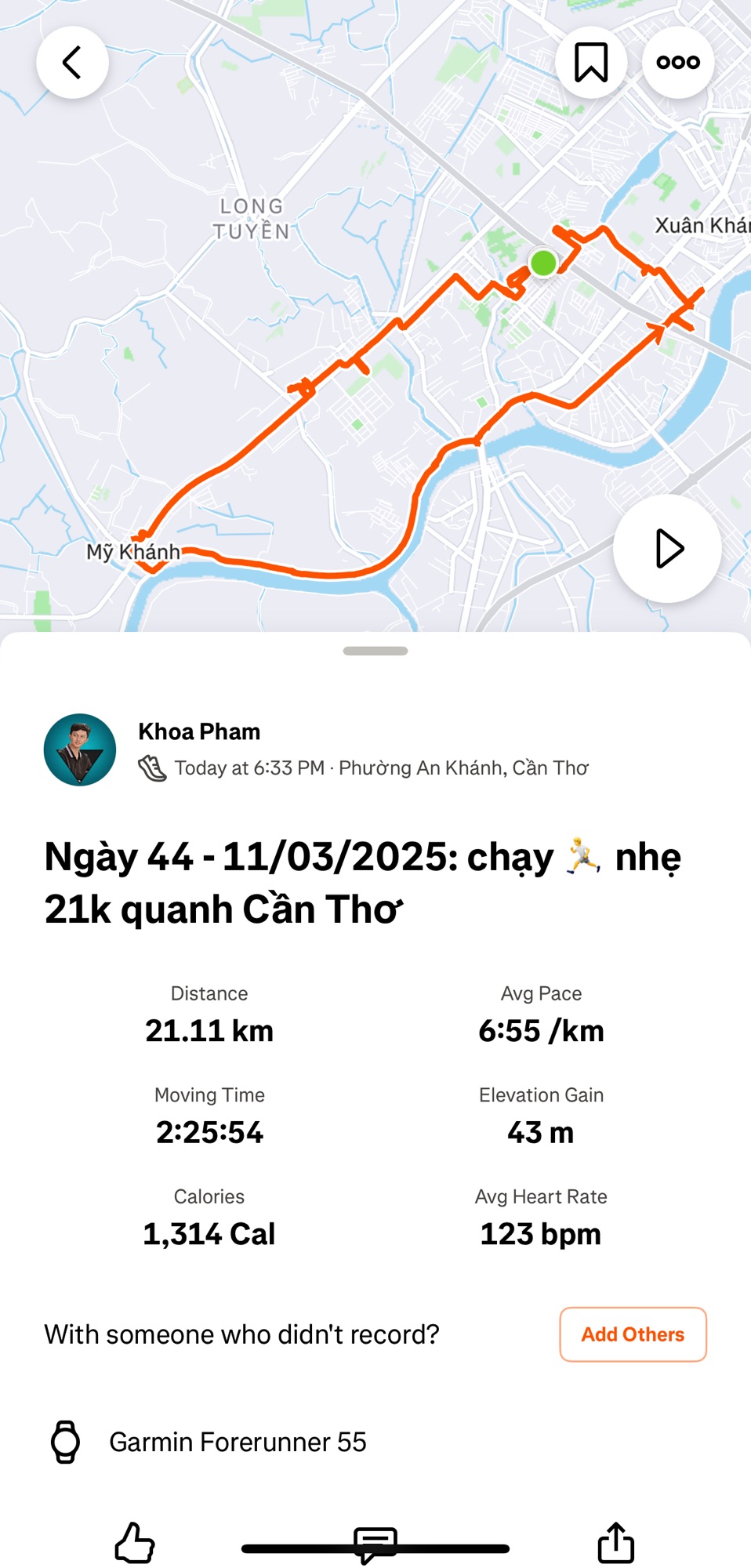
• Khoảng cách: 21.11 km
• Thời gian chạy: 2:25:54
• Pace trung bình: 6:55/km
• Nhịp tim 💗 trung bình: 123 bpm
• Calo tiêu hao: 1,314 kcal
• Chênh lệch độ cao: 43 m
• Thiết bị ghi nhận: Garmin Forerunner 55 - Phân Tích Nhịp Chạy (Splits)
• Những km đầu với pace dao động 6:37 – 6:48/km.
• Km thứ 5 có pace chậm hẳn (11:44/km), do dừng nghỉ, nạp nước 💧
• Sau km 6, pace quay lại 6:10 – 6:48/km.
• Km 20 có pace 7:54/km, có thể do tốc độ do mệt 😪 dần về cuối.
• Tốc độ nhanh nhất: 5:37/km ở đoạn cuối nước rút. - Nhịp Tim & Cadence
• Nhịp tim 💓 trung bình: 123 bpm, rất tối ưu cho một buổi chạy nhẹ, giúp cơ thể không bị quá tải.
• Nhịp tim 💗 tối đa: 159 bpm, do nước rút hoặc đoạn dốc lên ⬆️ cầu.
• Cadence trung bình: 166 spm, phù hợp với chạy đường dài.
• Cadence tối đa: 190 spm, ở những đoạn tăng tốc - Đánh Giá Hiệu Suất
• Đây là một buổi chạy 🏃 bền rất ổn định, kiểm soát nhịp tim tốt.
• Nhịp chạy có phần chậm lại ở km 5 và km 20, do lý do khách quan (dừng uống nước, điều chỉnh nhịp thở, tắc đường).
• Thời gian hoàn thành hợp lý cho một buổi chạy nhẹ, giúp tăng sức bền mà không gây kiệt sức.😥
• Tỷ lệ nhịp tim / pace tối ưu, Khoa sẽ tiếp tục duy trì phong độ này 👋 để chuẩn bị cho các buổi chạy 🏃 dài hơn. - Analysis of Run Day 44 – 11/03/2025: 21K Around Cần Thơ 🏃♂️
1. Overview of the Run
• Distance: 21.11 km
• Moving Time: 2:25:54
• Average Pace: 6:55/km
• Average Heart Rate: 123 bpm
• Calories Burned: 1,314 kcal
• Elevation Gain: 43 m
• Tracking Device: Garmin Forerunner 55
2. Pace Analysis (Splits)
• Looking at the split pace, there is good consistency in the early kilometers, ranging between 6:37 – 6:48/km.
• Kilometer 5 had a significantly slower pace (11:44/km), likely due to a stop for hydration, rest, or obstacles.
• After km 6, the pace returned to 6:10 – 6:48/km, showing good recovery ability.
• Kilometer 20 had a slower pace (7:54/km), possibly due to fatigue or slowing down to control heart rate.
• Fastest split: 5:37/km towards the end, indicating strong finishing speed.
3. Heart Rate & Cadence
• Average Heart Rate: 123 bpm, optimal for an easy run, keeping the body from overexertion.
• Maximum Heart Rate: 159 bpm, likely due to a sprint finish or an elevation gain.
• Average Cadence: 166 spm, suitable for long-distance running.
• Maximum Cadence: 190 spm, indicating bursts of acceleration.
4. Performance Evaluation
• This was a very steady endurance run with well-controlled heart rate.
• There was a noticeable slowdown at km 5 and km 20, possibly due to hydration breaks or external factors.
• Completion time is reasonable for a light long run, helping to build endurance without causing exhaustion.
• The heart rate-to-pace ratio is optimal, suggesting good conditioning for longer runs.
5. Improvement Suggestions
• Maintain a steady pace toward the end to avoid a drop in speed.
• If stopping at km 5 was necessary, consider slow jogging instead of a full stop to maintain momentum.
• Monitor hydration levels to prevent pace drops in the later stages.
Conclusion: This was a successful 21K endurance run with a well-managed pace and heart rate. Maintaining this performance can lead to a sub-2:20 or even a sub-2:15 half marathon in the future! 🚀 - 🔥 What Should I Drink After Running 21K? 🚀
Today, I burned 1,300 calories after running 21.1km 🏃♂️💨. My friend reminded me that I definitely need a big meal 🥘 to refuel! 😆
Now the big question 🙋 is: What should I drink after such a long run? 🤔
I’m considering:
🥤 Protein Shake (BodyKey Café Latte) – 17g protein, 22 vitamins & minerals
🥛 Chocolate Milk – A great balance of protein & carbs for muscle recovery
🍌 Banana Smoothie – Natural carbs & potassium to prevent cramps
🧃 Electrolyte Drink – To rehydrate and replace lost minerals
What do you guys think? Any suggestions?
Summary of the Product (BodyKey by Nutrilite – Café Latte Flavour)
This nutritious meal replacement shake is a formula dietary food designed to provide balanced nutrition. Key features:
• 17g of protein and 5g of fiber per serving
• Contains 22 vitamins and minerals
• No artificial colors or flavors
• No added preservatives
• Zero trans fats
• Plant-based protein from soy and chia seeds
• Net weight: 51g per pouch
Is This Enough Protein After a Half Marathon?
After a half marathon (21.1 km), your body needs proper recovery nutrition, particularly:
1. Protein for muscle repair (typically 20-30g recommended)
2. Carbohydrates to replenish glycogen (at least 50-100g)
3. Electrolytes and hydration
This shake provides 17g of protein, which is decent but slightly lower than the ideal post-race intake. To optimize recovery, consider:
• Adding a protein source (e.g., Greek yogurt, a protein bar, or another shake) to reach at least 25g.
• Pairing with carbs like a banana, oats, or whole-grain toast to replenish glycogen.
• Hydrating properly with water or an electrolyte drink.
Conclusion: While this shake is a good quick recovery option, it’s not fully sufficient alone. To maximize muscle recovery and energy replenishment after a half marathon, you should supplement it with additional protein and carbohydrates.
Ngày 44 – 11/03/2025: 21K Quanh Cần Thơ 🏃♂️
 Khoa Phạm
Leave a comment