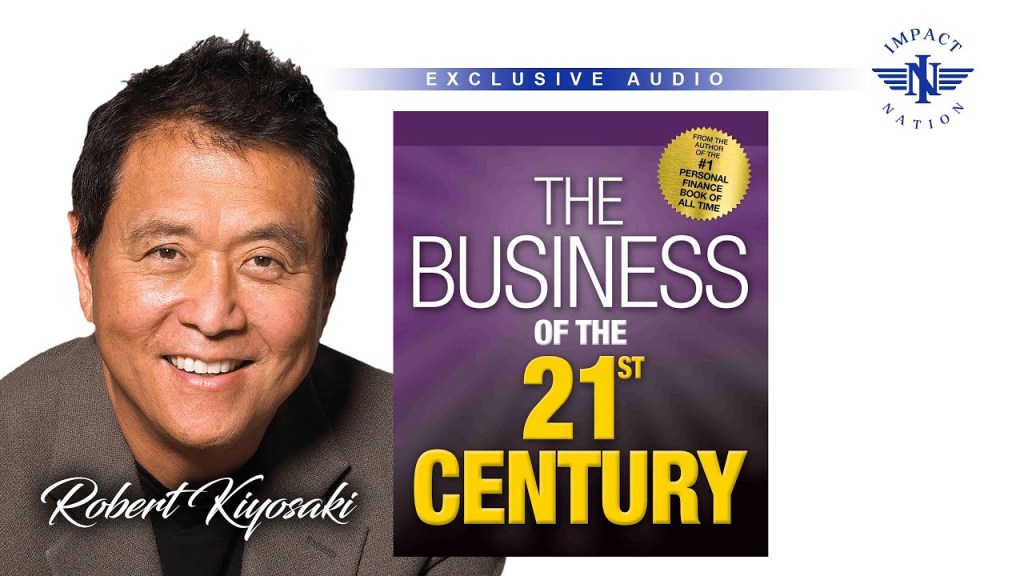
by Robert Kiyosaki with John Fleming and Kim Kiyosaki
Dedication
I dedicate this book, The Business of the 21st Century, to the millions of you who are at a crossroads in life, who are affected by the current economic crisis, and feeling helpless as to what you can do to secure your financial future.
I want you to know that these are, despite what they may seem, the best times to take control of your future.
I have spent my life educating people on how to attain financial freedom, and I know that this book, like the others in my Rich Dad series, will provide you with insight needed to create and sustain wealth for years to come.
Once you learn the truth of how money works, and the business opportunities available to you in the 21st century, you will be able to begin building the life you desire.
Acknowledgements
I would like to thank my wife, Kim, for her continued love and support, as well as my Rich Dad family, who has helped me get the message of financial education out to millions of people around the globe.
I would also like to thank John Fleming for his invaluable insight on network marketing, and Stuart Johnson, Reid Bilb, and the staff at Video Plus for their assistance in putting this book together.
Lastly, I would like to thank John David Mann and JM Emt for bringing their crafts and passions to this project.
Introduction
The economy is in tatters. Your job is in trouble—if you still have a job. And you know what? I’ve been saying it for years.
It took a global financial meltdown for most to hear it, but this book isn’t about how or why everything has gone to hell in a handbasket. It’s about why this bad news turns out to be very good news, if you know what to do about it.
I learned about business from two people: my father, who was a very well-educated, highly placed government employee; and my best friend’s father, who was an eighth-grade dropout and a self-made millionaire.
My real father suffered financial problems his entire life, and died with little to show for all the long years of hard work. My best friend’s dad became one of the richest men in Hawaii.
I thought of these two men as my Poor Dad and my Rich Dad.
Part One
Take Control of Your Future – Why You Need to Have a Business of Your Own
Chapter 1: The Rules Have Changed
We live in troubled times. The last few years have brought us a steady parade of fear and panic in the headlines, boardrooms, and kitchen tables across America.
Globalization, outsourcing, downsizing, foreclosures, subprime mortgages, credit default swaps, Ponzi schemes, Wall Street fiascos, and recession—it’s just one piece of bad news after another.
During the first few months of 2009, U.S. company layoffs reached about a quarter million per month. As I write this in late 2009, unemployment is at 10.2% and still rising. Underemployment—where your job stays in place but your hours and pay are drastically cut back—is even worse.
The rampant decline in gainful employment is a ravaging epidemic to which few are immune. From executives and middle managers, to administrative employees and blue-collar workers, from bankers to retail clerks—all are at risk. Even the healthcare industry, until recently considered a job-safe zone, is trimming away significant chunks of its workforce.
In the fall of 2008, a lot of people’s retirement portfolios suddenly lost half their value—or more. Real estate crashed. What people thought were their solid, reliable assets turned out to be about as solid as water vapor.
Job security is gone—a thing of the past.
In a 2009 USA Today survey, 60% of Americans polled said they see today’s economic situation as the biggest crisis in their lifetime.
Of course, you already know all this. But here’s what you may not know: none of this is really news.
Sure, it took a major economic crisis for people to start waking up to the fact that their livelihoods were at risk. But your income didn’t become at risk overnight—it was always at risk.
Most of the U.S. population has been living for years on the knife-edge precipice between solvency and ruin, relying on the next paycheck or two to meet each month’s expenses. Typically, there’s only a very thin cushion of cash savings—or, more often, no cushion at all.
That paycheck is called trading your time for money. And during a recession, it is the least reliable source of income there is.
Why? Because when the number of employed people starts dropping, there is less disposable income in circulation to pay for your time.
I told you so. Not to be an “I told you so,” but I did.
I’ve been saying this for years: there is no longer such a thing as a safe and secure job. Corporate America is a 20th-century dinosaur trembling on the edge of extinction. The only way for you to have a genuinely secure future is for you to take control of that future.
Here’s what I wrote in 2001 in a book titled The Business School for People Who Like Helping People:
“In my opinion, the United States and many Western nations have a financial disaster coming—caused by our educational system’s failure to adequately provide a realistic financial education program for students.”
That same year, in an interview for Nightingale-Conant, I said:
“If you think mutual funds are going to be there for you, if you want to bet your life on the ups and downs of the stock market, that’s your retirement you’re betting on. What happens if the stock market goes up—and then comes crashing down again when you’re 85 years old? You have no control.
I’m not saying mutual funds are bad. I’m just saying they’re not safe, and they’re not smart. I wouldn’t bet my financial future on them.
Never before in the history of the world have so many people bet their retirement on the stock market. That is insane. Do you think Social Security is going to be there to take care of you? Then you also believe in the Easter Bunny.”
In an interview I did in March 2005, I said this:
“The number one strength of a paper asset is its liquidity—and that is also its number one weakness. We all know there’s going to be another market crash, and we’re going to be wiped out again. Why would you do that?”
So, what just happened? There was another market crash, and many people got wiped out again. Why? Because our habits and mindset caught up with us.
In 1971, the American economy went off the gold standard. This happened without the approval of Congress, by the way, but the important thing is that it happened.
Why is that significant? Because it cleared the way for us to start printing more and more money, as much as we liked, without it being tied to any actual hard, real value.
This shift away from reality opened the gates for the biggest economic boom in history. Over the next three and a half decades, the American middle class exploded.
As the dollar devalued and the on-the-books value of real estate and other assets inflated, ordinary people became millionaires.
Suddenly, credit was available to anyone, anytime, anywhere. Credit cards began popping up like mushrooms after a spring rain.
To pay off those credit cards, Americans started using their homes as ATMs—refinancing and borrowing, borrowing and refinancing. After all, real estate always keeps going up in value, right?
Wrong.
By 2007, we had pumped as much hot air into this financial balloon as it could take, and the fantasy came crashing down to earth again. And it wasn’t just Lehman Brothers and Bear Stearns that collapsed. Millions lost their 401(k)s, their pensions, and their jobs.
In the 1950s, when General Motors was the most powerful corporation in America, the press picked up a statement by GM’s president and turned it into a slogan that carried for decades:
“As GM goes, so goes the nation.”
Well, folks, that may not be all good news—because where GM went in 2009 was into bankruptcy.
And by that same summer, the state of California was paying its bills with IOUs instead of cash.
Right now, the percentage of Americans who own their homes is dropping. Mortgage foreclosures are at an all-time high. The number of middle-class families is shrinking. Savings accounts are smaller—if they exist at all—and family debt is greater.
The number of people living officially below the poverty line is rising rapidly. The number of people who are working beyond the age of 65 is increasing.
Bankruptcies are going through the roof. And many Americans do not have enough to retire—not even close.
Has all this bad news got your attention? Sure, it has. And you’re not alone.
Americans everywhere have finally stopped rolling over and hitting the snooze button. Great. Now you’re awake to what’s going on—and it isn’t pretty.
So let’s take a deeper look and see what it really means, and what you can do about it.
It’s a New Century
When I was a kid, my parents taught me the same formula for success that you probably learned:
“Go to school, study hard, and get good grades, so you can get a secure, high-paying job with benefits. And your job will take care of you.”
But that’s Industrial Age thinking. And we’re not in the Industrial Age anymore.
Your job is not going to take care of you. The government will not take care of you. Nobody’s going to take care of you.
It’s a new century, and the rules have changed.
My parents believed in job security, company pensions, Social Security, and Medicare. These are all worn-out, obsolete ideas—left over from an age gone by.
Today, job security is a joke. The very idea of lifetime employment with a single company—an ideal so proudly championed by IBM in its heyday—is as anachronistic as a manual typewriter.
Many thought their 401(k) retirement plans were safe. Hey, they were backed by blue-chip stocks and mutual funds. What could go wrong?
As it turned out, everything could go wrong.
The reason these once-sacred cows no longer give any milk is that they are all obsolete.
- Pensions.
- Job security.
- Retirement security.
It’s all Industrial Age thinking. We’re in the Information Age now—and we need to use Information Age thinking.
Fortunately, people are starting to listen and learn. It’s a shame that it takes suffering and hardship to bring the lesson home, but at least the lessons are hitting home.
Every time we experience a major crisis—the dot-com bust, the economic aftermath of 9/11, the financial panic of 2008, and the recession of 2009—more people realize that the old safety nets just won’t hold up anymore.
The corporate myth is over.
If you’ve spent years climbing the corporate ladder, have you ever stopped to notice the view?
“What view?” you ask.
The rear end of the person in front of you. That’s what you get to look forward to.
If that’s the way you want to view the rest of your life, then this book probably isn’t for you. But if you are sick and tired of looking at someone else’s behind, then read on.
As I write this, unemployment is still on the rise. By the time you read these words, who knows—the situation may have changed.
But don’t be fooled. When employment and real estate values turn around, and credit loosens up again—as they inevitably will—don’t fall back into that same old sense of false security that got you, and the rest of the world, into this mess in the first place.
In the summer of 2008, gas prices were soaring over $4 a gallon. SUV sales sank like a stone, and suddenly everyone was on the small-car and hybrid bandwagon.
But look what happened next. By 2009, gas prices had fallen back down below $2, and—so help me—people started buying SUVs again.
Do we really think fuel prices are going to stay nice and low? That gas prices are down for good now, and therefore gas guzzlers make perfect sense to buy?
Can we really be that shortsighted? I’m trying to be nice here. The word I was going to use was “stupid.”
Unfortunately, the answer is yes. We aren’t just fooled once—we let ourselves be fooled over and over again.
We all grew up hearing the fable of the ant and the grasshopper. But the overwhelming majority of us keep living with the foresight of a grasshopper anyway.
Don’t be distracted by the headlines. There is always some idiotic buzz going on that tries to pull your attention away from the serious business of building your life.
It’s just noise. Whether it’s terrorism, recession, or the latest election-cycle scandals—it’s got nothing to do with what you need to be doing today to build your future.
During the Great Depression, there were people who made fortunes.
And during the greatest boom times—like the real estate surge of the 1980s—there were millions of people who neglected to take charge of their future, who ignored everything I’m going to share with you in this book, and who ended up struggling or broke.
Most of them, in fact, are still struggling or broke today.
The economy is not the issue. The issue is you.
Are you angry?
- At the corruption in the corporate world, at Wall Street, and the big banks that let this happen?
- At the government, for not doing enough—or for doing too much, or for doing too much of the wrong things and not enough of the right ones?
- At yourself, for not taking control sooner?
Life is tough. The question is: what are you going to do about it?
Moaning and groaning won’t secure your future. Neither will blaming Wall Street, the big bankers, corporate America, or the government.
If you want a solid future, you need to create it. You can take charge of your future only when you take control of your income source.
You need your own business.
Chapter 2: The Silver Lining
On July 13th, 2009, Time Magazine ran a piece on page two called 10 Questions for Robert Kiyosaki.
One of the questions asked of me was this:
“Are there opportunities to create new companies in this turbulent economy?”
“Are you kidding?” was my first thought.
Here is how I answered:
“This is the best time. When times are bad is when the real entrepreneurs emerge. Entrepreneurs don’t really care if the markets are up or down—they’re creating better products and better processes. So, when somebody says, ‘Oh, there’s less opportunity now,’ it’s because they’re losers.”
You’ve heard an awful lot of bad news about the economy. Ready for the good news?
Actually, the bad news is the good news.
I’ll tell you the same thing I told Time Magazine:
A recession is the best time to start your own business.
When the economy slows down, entrepreneurialism heats up—like a stoked-up wood stove on a cold winter night.
Q: What do the Microsoft and Disney empires have in common, besides the fact that they are both hugely successful, billion-dollar businesses that have become household names?
A: They were both launched during a recession.
In fact, more than half the corporations that make up the Dow Jones Industrial Average got their start during a recession.
Why? Simple.
In times of economic uncertainty, people get creative. They break out of their comfort zones and take initiative to help make ends meet. It’s a matter of good old-fashioned American entrepreneurialism at its best.
When the going gets tough, the tough get going.
For one thing, the market for new opportunity is ripe during tough economic times.
Five years ago, when housing values were soaring and credit was available everywhere, nobody was hungry. People’s bellies were full, they felt safe, and few were looking for any alternative means of income.
Employees weren’t worried about the financial stability of their employers, or whether a pink slip might be in their future.
But now that layoffs are rampant, and everyone is worried about what the future holds, millions of people are soberly re-evaluating their finances—and realizing that if they want to have a secure future they can count on, they’re going to have to come up with a Plan B.
People today are hungrier than ever to earn extra money. And because of that, they are more receptive and more inclined to open their minds to new avenues.
In fact, this was true even before the recent economic meltdown. Ever since the 1980s—and especially since the turn of the century—the drive to control our own economic futures has been building.
Here’s what the U.S. Chamber of Commerce said in a 2007 report titled Work, Entrepreneurship, and Opportunity in 21st Century America:
“Millions of Americans are embracing entrepreneurship by running their own small businesses.”
Now, I’m no economist—but I know someone who is: Paul Zane Pilzer.
Paul is a whiz kid. He was Citibank’s youngest-ever vice president, then left the banking world to make millions going into business for himself.
He’s had a few New York Times bestsellers, predicted the Savings and Loan crisis before it happened, and served as an economic adviser in two presidential administrations. He’s someone worth listening to.
Paul talks about a 180-degree shift in cultural values around the nature of career paths—with the conventional corporate-employee career structure giving way to the entrepreneurial path.
“The traditional wisdom in the second half of the 20th century,” says Paul, “was to go to school, get a good education, and go to work for a large company. The idea of going into business for yourself was most often regarded as risky—admirable, perhaps, but risky and maybe a little crazy. Today, it’s completely the other way around.”
And Paul’s right.
That U.S. Chamber of Commerce report I mentioned also refers to a Gallup poll finding that:
- 61% of Americans say they would prefer to be their own boss.
- Another poll, by the Fresno research firm Decipher, found that 72% of all adult Americans would rather work for themselves than for a job.
- 67% think about quitting their jobs regularly or constantly.
And it’s not just about making a living. It’s also about the quality of how we’re living.
People are waking up to the fact that they want more control over their lives.
They want to be more connected to their families, be in charge of their own time, work from their homes, and determine their own destinies.
In that Decipher study, 84% of respondents said they would be more passionate about their work if they owned their own business.
The number one reason they gave for wanting to work for themselves?
“To be more passionate about my work and my life.”
 Khoa Phạm
Leave a comment